
Release:
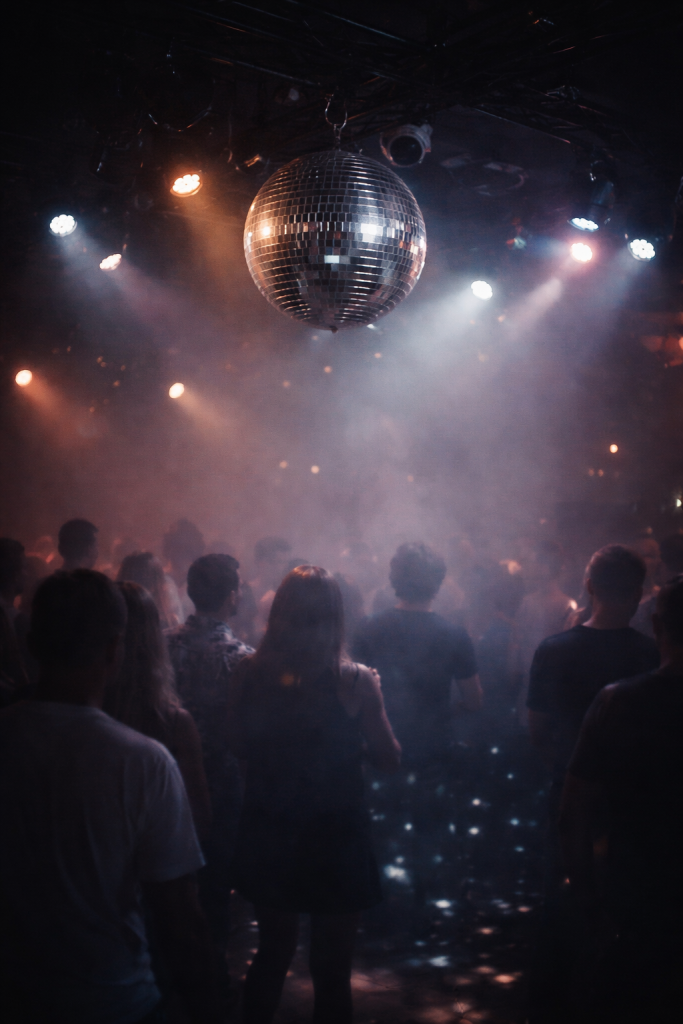
There’s a moment every DJ knows. The lights drop. The booth warms up. The dancefloor locks in. And above it all sits the disco ball doing its job. Tiny mirror tiles throwing light across the room. Walls flickering, faces glowing, that proper club magic.
But here’s the thing.
Disco balls have been struggling.
After years of sweaty basements, rooftops, warehouses and festival fields, those tiny mirror tiles start to loosen. Edges lift. Squares drop. The shine fades. The ball still spins, but something’s missing.
You might not notice it straight away.
But the light does.
Once the tiles start falling, reflections become uneven. The glow softens. The room loses that little bit of sparkle that makes a dancefloor feel alive.
And it turns out the problem might be worse than we thought.
The Hidden Problem With Disco Ball Cleaners
For decades, venue owners have relied on standard cleaning sprays to keep disco balls looking sharp.
The problem is what happens underneath.
Many traditional cleaners gradually weaken the adhesive that holds the mirror tiles to the sphere. Others polish so aggressively the reflective squares begin lifting from the surface.
You’ve probably seen the signs.
Loose mirrors.Patchy reflections.A once proud disco ball slowly losing its shine.
And once those tiles start falling off, the structure weakens.
Light scatter becomes uneven.The glow fades.
That’s where things got interesting.
The Investigation
About twelve months ago, the Disco Infiltrators Lab inside Data Transmission started looking into it.
The goal was simple.
Find a way to restore disco balls without weakening their mirror structure.
What started as a simple cleaning project quickly turned into something much bigger.
After months of testing adhesives, coatings and reflective surfaces, the team developed what is now known as the MirrorSphere Structural Blueprint.
And from that blueprint, something new emerged.
The Science Behind The Shine
At the centre of the system sits a proprietary reinforcement process powered by something our lab team call:
L.R.E.T Technology
Light Refraction Enhancement Technology.
Which naturally led to a very serious piece of dancefloor science.
The Disco Radiance Equation.
Dᵣ = (M² × L × B) ÷ G
Where:
Dᵣ = Dancefloor RadianceM² = Mirror Density per BallL = Light Velocity from RigB = Ball Structural IntegrityG = Glitter Loss Factor
Most traditional disco cleaners slowly reduce B and increase G.
This explains why older disco balls start losing their shine.
So the lab built a formula that does the opposite.
Introducing The Prismator 3000
After a year of testing, Data Transmission now unveils the result.
The Prismator 3000
A next generation disco ball restoration system built using the DT MirrorSphere Blueprint.
The formula works by penetrating the microscopic gaps between mirror tiles and sealing them using MirrorBond Flex Adhesion.
This creates three key upgrades.
Mirror Tile ReinforcementStructural Ball HardeningEnhanced Light Refraction
Put simply.
It puts the shine back in your balls.
And the glitter back in your box.
Field Testing
The Prismator prototype has spent the last six months undergoing testing inside what our engineers politely describe as high-intensity dance environments.
Clubs.Warehouses.Festival tents.
Results showed disco balls treated with Prismator maintained 94 percent mirror retention after extended use.
Meaning the tiles stayed where they belong.
On the ball.
Built For Electric Paradise Dancefloors
The Prismator 3000 was built for the kind of rooms where lighting really matters.
Spaces where reflections bounce across the ceiling, and the disco ball becomes part of the atmosphere.
Some dancefloors demand serious sparkle.
Some operate like a full Glitterbox of light.
Others run on pure disco joy, the kind of place powered by nothing but Big Love.
And every now and then, you walk into a room that feels like a complete Electric Paradise.
The Prismator was designed for all of them.
Availability
The Prismator 3000 Disco Ball Restoration System will soon be available via the Data Transmission supply department.
Each kit includes:
MirrorSphere Blueprint schematicsPrecision Ball Application ClothStructural Glitter Reinforcement Formula
Because every venue deserves a disco ball that actually shines.
And every dancefloor deserves a bit more glitter.
Even if some people might say chasing the perfect disco ball shine is a bit of a…
Fool’s Paradise.
Prismator 3000 Technical Specifications
For venues, lighting engineers and disco ball maintenance teams who want the details.
Product NamePrismator 3000 Disco Ball Restoration System
Technology PlatformDT MirrorSphere Blueprint
Core ProcessMirrorBond Flex Adhesion
Light Refraction SystemL.R.E.T Technology (Light Refraction Enhancement Technology)
Performance Metrics
Mirror Tile Reinforcement IndexUp to 94% mirror retention during extended dancefloor testing.
Dancefloor Radiance OutputEnhanced light scatter across 360° reflective surfaces.
Glitter Retention FactorSignificantly reduced glitter loss compared to traditional disco ball cleaners.
Structural Ball Hardness RatingImproved mirror grid stability under high bass vibration environments.
Environmental Testing
Prismator 3000 has been tested in a range of high intensity dancefloor conditions including:
• Underground club basements• Large festival tents• Rooftop venues• High humidity warehouse environments
During testing, disco balls treated with Prismator maintained consistent reflective output across extended lighting cycles.
Application System
Each Prismator 3000 kit includes:
MirrorSphere Blueprint maintenance guidePrecision Ball Application ClothStructural Glitter Reinforcement Formula
Recommended application time: 3–5 minutes per disco ball.
Full radiance restoration occurs within one rotation cycle under standard club lighting rigs.
Recommended Use
Ideal for:
• Nightclubs• Festival production teams• Event lighting engineers• Disco ball restoration specialists
Compatible with all standard mirror disco balls from 20cm to 120cm diameter.
Lab Certification
Developed by the Disco Infiltrators Lab after 12 months of structural disco ball research.
Field testing conducted across multiple dancefloor environments to validate improved mirror adhesion and enhanced reflective performance.
The post The Disco Ball Crisis Nobody Talks About appeared first on Data Transmission.
Dougal Fox crafts label-driven journey for EG Spotlight
Featuring tracks by Moshic, Lexicon Avenue, Lost Astronaut, Michael Cassette, and more. Photo credit: Dougal Fox – Facebook Dougal Fox returns to EG with his latest contribution to the EG Spotlight series, presenting the 329th episode, which is now available on SoundCloud and Mixcloud. The mix arrives as a focused [...]| Play | Cover | Release Label |
Track Title Track Authors |
|---|