
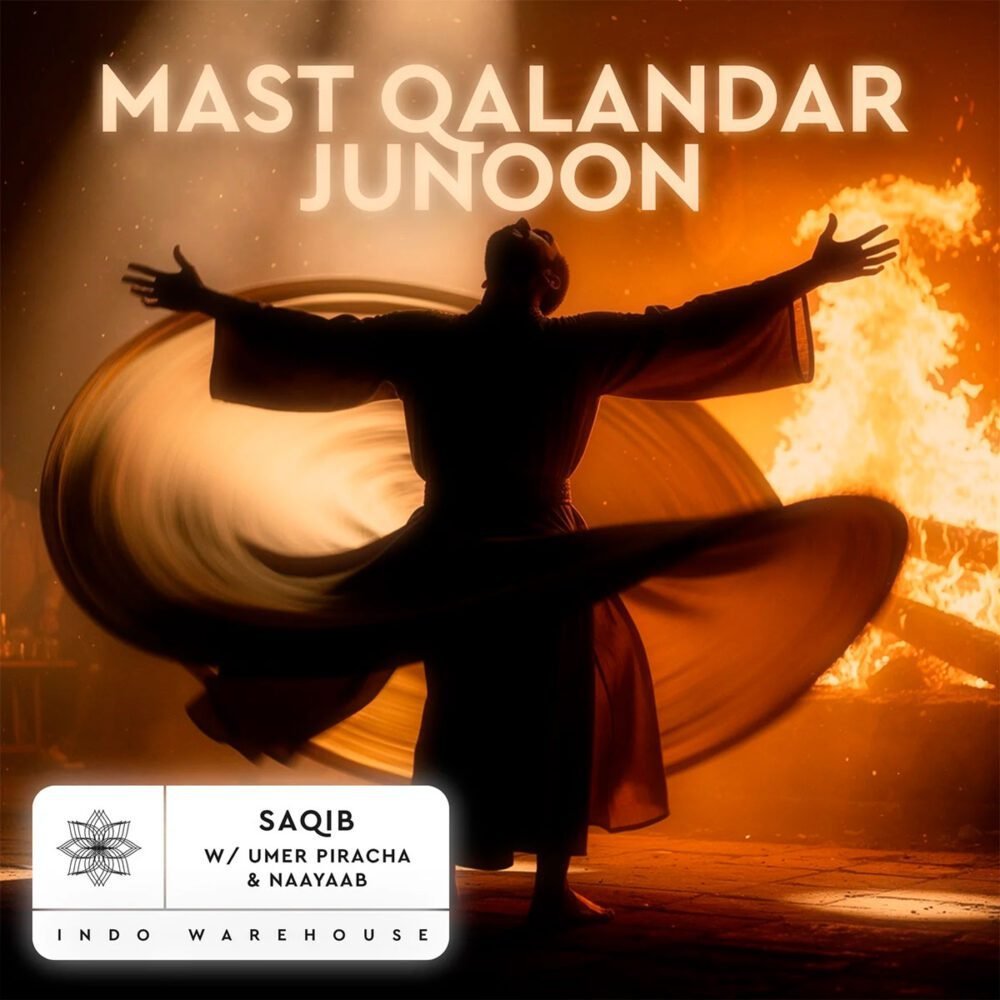
Release:
There is a shift happening on dancefloors. Not louder. Not faster. Just more intentional.
Photo credit: Indo Warehouse – Bandcamp
A growing wave of artists is bringing cultural identity back into electronic music in a way that feels natural, rather than forced. It is less about borrowing, more about belonging. Indo house sits right in the middle of that change.
But even as the sound gains attention, it is often misunderstood.
I caught up with NYC-based producer Saqib during the final Ship of Fools boat at Miami Music Week, where the conversation quickly turned to that confusion.
“It is not the same as Bollywood. And it does not come from just one place. It can come from Pakistan, Bangladesh, Sri Lanka, Nepal, the whole subcontinent. It also spans many languages, Urdu, Bangla, Hindi, Marathi, Telugu, and more.”
That distinction matters. What is forming here is not a niche. It is a broader cultural expression, finding its place inside global club music.
At its core, Indo house leans on groove and repetition. Percussion carries the energy. Vocals often hold history. The goal is not impact, it is movement over time. Sets breathe differently. The crowd responds differently.
That context gives ‘Mast Qalandar / Junoon’ a weight that goes beyond a typical club release. It is not just another track built for the floor; it is a reinterpretation of something that already carries meaning across generations.
Out now on Indo Warehouse, the EP brings together Saqib, Multan-rooted Sufi vocalist Umer Piracha, and Mumbai-based artist Naayaab, placing a centuries-old composition into a contemporary club setting.
The opening track reimagines the Sindhi folk classic ‘Mast Qalandar’, a song embedded in the cultural memory of the region. Rooted in Sufi tradition, it was written in honor of Lal Shahbaz Qalandar, one of the most revered saints of Sindh, and has lived through generations in both film and live performance.
For Saqib, that responsibility was present from the very beginning.
“I felt that weight long before Umer Piracha stepped into the studio. Even before we started the first beat.”
The connection to the source remains in the lyrics and spirit, while the production moves in a different direction. New instrumentation, new structure, a different environment. The balance is subtle, but it is what allows the track to exist both as a cultural expression and a club record.
It is the kind of release that only works when the intent behind it is real.
This is also where Indo Warehouse has carved its space.
Since its launch, the collective has focused on building a clear identity, one that connects heritage with contemporary club culture without reducing either side. The rise has been fast, but it has not felt accidental.
“I see it becoming a much wider cultural and musical movement in the coming years,” Saqib says.
That may be the real takeaway.
Indo house is not here to replace anything. It is not competing with house or techno. It is adding a new layer, one rooted in identity, language, and history, but designed for the present moment.
And if it continues to grow, it will not be driven by hype.
It will be because it feels real.
SAQIB, Umer Piracha, and Naayaab’s ‘Mast Qalandar / Junoon’ is out now. Stream and download here.
Follow Indo Warehouse: Website | Spotify | Soundcloud | Instagram
The post Indo house: identity, not trend appeared first on Electronic Groove.
Lizzie Curious, Charlie Big and Shanie drop ‘Rub Ah Dub’
Out now on Nuhope Entertainment. Photo credit: Lizzie Curious / Charlie Big / Shanie – AI-generated composite; source imagery provided by artist representation Lizzie Curious, Charlie Big, and Shanie have released their new collaborative single ‘Rub Ah Dub’, out now via Nuhope Entertainment. The track arrives following early teasers in [...]| Play | Cover | Release Label |
Track Title Track Authors |
|---|